The Fall season is always a busy time in Florida as it marks not only the start of the annual stretch of well loved winter holidays but also the beginning of the height of the arts, culture and tourism season here in the Sunshine State. After two years of precautious, arms length and virtual engagements due to pandemic health concerns, this autumn feels like it was the busiest on record. Coming out of a whirlwind world tour that started in Lee County last October and ended last week in Wynwood, visual and performance works of Tara A. Chadwick made stops in Hong Kong, Sydney, London, Zurich, Laguna Beach, Rome, Palma de Mallorca and the Milk of Dreams Venice Biennale along the way. Installation and performance work was manifested locally at Miami Beach Botanical Garden, Greenspace Miami, downtown Fort Lauderdale, Miramar and Everglades National Park. Collaborations are ongoing and developing. Follow and message me on instagram for invitations & inquiries!
Below are a few key highlights of the year in review:
Upcoming intergenerational enrichment experience exploring winter science & celebrations at Sunset Lakes Community Center next Wednesday, December 21st at 10:30-11:30 am.
Chono Thlee: Sparking a New Era in Seminole Art exhibition curated by Tara Chadwick on view through January 10th at History Fort Lauderdale.
Papalotl (Butterfly) Project Social Innovation Fellow at Cogenerate.
Special thanks to Akeesha Nadjiwon Footman for being the first to add one of the limited edition Matriarch prints to her prestigious Canadian fine art collection. And to each and every one of you who keeps on supporting me through the many ideas, goals and the often intense work that goes into making those dreams become our reality. I am so thankful for YOU. Let's keep on building wider, stronger, smarter, together!
As the rainy season cloaks us in the cavern of rhythmic cycles of downpours and sunshowers... we wait cautiously to see what the east winds bring our way and do our best to prepare ourselves for the disciplined routines that must come with the close of the summer break and the opening of the new school year.
As usual the summer flew by in the blink of an eye, filled with memories of joy and sorrow, fear and bravery, optimism and despair... it was like a microcosm of many lives lived in fullness, watching the sun rise and fall across lands familiar and yet unrecognizable.
We listened to each other and to the sounds of the earth conversing with us through her various chorus of voices, of which we are but a fleeting melody. Remembering our past, we set a course of goals for our future, together. As individuals seeking the pursuit of our greatest possible development while simultaneously working to find a way to ensure that all beings are afforded equitable access to this opportunity. Life is not easy but it is in the struggle for balance that we find equilibrium.
Here are a few highlights of summer activities:
Mesoamerican Danza performance and workshop at Broward Schools Equity Conference
Education panel with Seminole Art from the Frontlines Artists at Florida Alliance of Art Educators
Mesoamerican Danza performance workshop at Miramar Cultural Center photography by Adrienne Chadwick and Reina Christian.
Pat Bellanger Memorial at Rural Coalition Retreat in Onigum, Minnesota
Reconnecting with family (Reina and Evy, EBB and WM, Julia, Louis, Amy and Katy, prairie, wetlands, woodlands, sage, sweetgrass and that word for bergamot that I can't remember)
In the weeks and months to come, our lives will become overflowing with tasks and obligations, timelines and due dates, homework and classwork and assignments of all kinds... but for now, we are thankful for a few moments of calm, still reflection on the life we've lived and the path we are trodding... we will do our best to keep moving toward that goal of healing while being healed, of figuring it out while helping others figure it out, of learning while doing... we are because we are.
These are some of the things that come to mind during this time of year when we celebrate the Summer Solstice in this region of our planet. This year we took a moment to reflect on the strong rays of sunlight that were literally shining through the clouds surrounding us this longest day of the year. As human beings, we all have those things which distract us, just as we all have gifts that are immeasurably important to the human family. A condition in which each of us has the opportunity to fully develop and share those gifts with all of humanity is, for me, the ideal goal of a healthy economy. I also published an article that describes some of the current work that I've been helping Fort Lauderdale Historical Society engage in which can be found in this month's edition of InterpNews (p. 84-88, there is a great article on concretions immediately preceeding mine too!).
This month I also had the opportunity to share some of these thoughts briefly with a gathering of a few of Broward County's brilliant people. I'm looking forward to contributing more to widening our base of passionate, accountable and inspired community builders.
Strolling along what seemed like an endless sidewalk down Dade Avenue on this 200th anniversary of the start of the Seminole Wars... I happened to spark up a conversation with one of my co-walkers. Till that moment, I truly had no idea so many of the fair goers were out-of-towners travelling to South Florida just specifically to take in #art. Art Basel 2017 is officially a wrap having shown approximately $3.5 billion work of art, and seeing over 82,000 participants [see press release and end of show report] .
...reminds me of #CometotheWell
(photo: T. Chadwick)
According to artsy.net, the Pace Gallery had a successful run, placing one work worth $12 million. The show’s new layout was so much easier to
follow and navigate, with beautiful hanging garden center lounge areas. I did miss
the delicious, stadium priced lunch offerings, although the BC taco truck
outside did a wonderful job of filling the afternoon void with delicious shrimp
tacos and “avocado salsa.”
Pace Gallery (photo: T. Chadwick)
Inside the walls of Art Basel, I found a whimsical and
wondrous survey that pushes my boundaries of contemporary art. From plastic
bags to classic painting and sculpture to, my favorites:
performance, kinetic and live painting, this show truly had something for
everyone to enjoy.
Mexico City Mural in Miami Beach
(Thursday photo: T. Chadwick)
Mexico City Mural in Miami Beach
(Friday photo: T. Chadwick)
Of these, I really enjoyed watching the mural in process
presented as part of Mexico City's #RestorationofaMural. To my North American eye, the overlays of
vellum on painted campaign slogans was unexpected, a little jarring, and,
similar to my own recent political experiences, I couldn’t figure out if the
art was for or against the will of the majority of the people. The tools,
brushes, and process of creating circles and lines took me back to the 9th
grade computer class called “data,” where everything we ever wanted to program had
to be rendered as a circle or a line. Watching the muralist and assistant add
elements of the mural was almost like watching an archaeological excavation in
reverse. Careful measurements, ancient techniques, tools for the future.
#Reparations David Castillo Gallery
(photo: T. Chadwick)
‘This year’s show definitely had a great energy with its new look, and our booth was extremely well-received. Within the first two hours of the fair, some of our gallery’s most important clients came to the booth. With the sale of a major Lyle Ashton Harris piece and an important group of clients visiting us early on in the fair, it is clear that this year’s fair was punctuated by significant collectors in attendance and as always, there was interest from buyers early on in the show.’ David Castillo, Owner, David Castillo Gallery, Miami Beach (In quotes from Art Basel post show press release.)
...miscellaneous unnamed photos, except for Maggie by #ChuckClose...
(photos: T. Chadwick)
Basel blog – Art Basel Conversations
#EdgarHeapofBirds discussing #Indigenous #Art
(photo: T. Chadwick)
One of the problems I’ve had with Art Basel and contemporary
art in general, is that distinction between what one of the art experts this
week describes as “pastoral” art versus the elevated stature and value of
“fine” art. For example, there were many examples of fabric art during this
year’s Art Basel show, one of these was a giant, larger-than-life
pseudo-dreamcatcher created by an artist in the UK. When I first set eyes upon
the purple and black mass I was surprised, since generally in fine art shows
such as Art Basel, this type of work is relegated to the low rank of “craft” or
“tribal art.” Immediately I looked closer to see if I could see the origin
story of the dreamcatcher woven within the fabric. As I surveyed the types of
twists and turns used in the weaving, sadly, I saw nothing representing the
cultural teachings or history that traditional dreamcatchers convey, in fact to
me this weaving was empty. An empty shell, a hollow reproduction of a
traditional art form containing nothing of the beauty and love that it is meant
to hold. I still wonder about the artist and their intent in making this piece,
but more, I wonder about the gallery that decided to choose this as their main
showcase. What were they thinking? That Indigenous art forms co-opted by white
European artists are flattering? Honoring? Even when indigenous people
themselves are not welcomed to participate as artists, curators or even spokes
people?
#RichardHughes Birmingham, UK
(photo: T. Chadwick)
Seeing the Art Basel Conversation titled “What of Indigenous
Art Now” was a boon to me. I was so excited that someone decided to bring this
topic to the conversation. For too many years, I’ve seen incredible Indigenous
artists, with traditional, folk and contemporary styles, struggle to make ends
meet… invisible in the art magazines… absent from the juried shows… neglected
by collectors and curators. This is changing. But way too slowly. And still,
European artists using Indigenous themes get much more recognition and
appraisal value than Indigenous artists using any theme.
#Oaxaca
(photo: T. Chadwick)
I was so glad to be
able to take part in this conversation. In fact, it was, in part, a
retrospective on Indigenous Art over the past #525yearsofresistanceandsurvival,
it’s been 25 years since 1992. Many of the prominent Native owned and operated
galleries have since closed their doors. But there are a few still in
operation, and a few that have opened since the Sesquicentennial resurgence of
Indigenous art. In my view, the more we have conversations that lead to strategies
for how the arts and business community can best support artists and especially,
Indigenous artists, the stronger our community will grow together.
[Links to the program are available here: ... Indigenous Art Now... and below you can watch the official recording of the "What of Indigenous Art Now?" #ARTBASEL conversation - my remarks can be heard at minute 42]
Basel Blog – #ArtMiami
#ArtMiami / #Context
(photo: T. Chadwick)
This year, once again, I didn’t get to Pinta, Superfine, Red
Dot, Context, Untitled or Scope. I really do wish I’d had time to make it over
to Scope, as I enjoyed the Conversation with Edgar Heap of Birds about
the interconnection between art and history. I particularly wanted to see the “sign
post” he did marking this land as Tequesta territory, a site specific artwork
in relation to the Miami Circle just a few miles away.If anyone happened to snap a pic of it, I’d
surely appreciate having a glimpse!
#AndyWarhol at super stuffy Archeous/ Post Modern
(photo: T. Chadwick)
I also wanted to get to Context because I’m interested in
comparing the overall content between each show. Surprisingly, I found Art Miami
to have a more standoffish feel than Art Basel, something I was definitely not
expecting! My favorite aspects of this show, like Basel, were in the margins… “Unleashed”
had an inspiring piece in the entry way featuring a world map in thread, surrounded
by fabric strips of messages by fair goers, flanked by multiple display screens
flashing still and video images of colourful fashions and wearable art from
India and Asia.
#Unleashed #ConnectingThreads @ Art Miami
(photo: T. Chadwick)
My other favorite piece from Art Miami was “DeepSee,” an incredible
collaborative experience integrating natural vegetation, visual art and visual
reality, all with an action based intended outcome of raising awareness,
interest and motivating everyone to set a goal to take at least one action to support
the earth’s ability to heal herself from the daily stress we inflict upon
her.I loved being able to literally
step inside of the beautifully painted canoe and although I generally dislike
the popular innovation of virtual reality imaging, this VR canoe journey was so
very beautiful with its overlapping integration of earth, space and water
travel, it was impossible not to love.Congrats to Dita, Jared, Houston and the FIU advisory council for
creating this inspiring experience.
Although I’m fairly new to the Art Basel scene (this was
only my 3rd year attending events at Miami’s signature week of high profile,
contemporary art fairs which include but are certainly not limited to the
world-renowned #ArtBasel,) I loved my inaugural experience
with the Basel House Mural Festival.
#SFLBloggers
(photo: T. Chadwick)
Even before attending my first Miami Art Week events three
years ago, I’d heard the perspective of local South Florida artists who too
often struggle for recognition, attention of gallery and representatives, and interest in their work
from the local and global community. Basel House set out to address this
problem by showcasing a few of the artists that have infamized the walls of
Miami’s Wynwood Arts District.
#Wynwood #Wall Tag
(photo: T. Chadwick)
As a kid, this was the factory outlet side of town – large, vacant industrial lots, warehouses, some still used for direct and commercial sales of shoes, washing machines, and bric-a-brack, now almost unrecognizable due to the incredible splashes of colour disguising every wall, coffee shops and cute little trendy places to eat, drink and be merry.
...before...
(Friday photo: T. Chadwick)
Basel House Mural Festival took place between the old RC Cola Plant and Wynwood Brewing Co. It was an homage to the street artists who work every day to bring color and consciousness to our concrete jungle. Featured artist Ruben Uribe is a masterful installation and graphic artist who describes his style as “post graffism popular urban art.”
The opening was unlike any other I’d ever experienced
complete with Rolling Stones sponsored ice cream, a delicious dinner bar
of salad, quinoa and paella, and as much kombucha as you dared to consume… One
of the marketing pieces I enjoyed was the live screen printing of Basel House cloth
tote bags to hold all your swag for the night.It was a great evening to connect with the beauty of what local mural
art brings to Miami during Art Basel and all year through.
I love art, but I’m not one to party much… don’t get me
wrong, I love dressing up as much as the next kid, but I’d rather go see a live
orchestra, ballet or jazz performance than try to strike up meaningless
conversations with a thousand people I don’t know and still won’t know
tomorrow.That said, I did enjoy the hubbub
of going to the “Basel Brunch” at the Sagamore this weekend. Rain pouring. Wind
whirling through what’s left of the art deco buildings my grandmother skipped past
as an 8-year-old in 1931, on her way to spend her day on the beach while her
mother tended her ailing father under a prescribed winter in Florida, the antidote
to his WWI inflicted health issues. The rivers of rainwater filled the streets
as we searched for a semi-safe spot to cross the deluge.
Our first stop was the Muse Art Exhibit, a miniature version
of the much-anticipated Muse Art Fair, scheduled for launch during Art Miami
Wee 2018. Housed in the front lobby of the Hampton Inn, curator and lead
organizer Q stopped to chat about the exhibit and plans for the 2018 art fair.
Then we dashed off in the rain across the street to the
Sagamore. It was my first time to the iconic beach front property... filled
with a warm mass of dripping wet bodies, this brunch was jam packed with
several hundred of the most hard and happy art lovers on the beach. Despite the
torrential downpour outside, Basel Brunch goers were chipper, friendly and happy
to be inside. Pastries and mimosas abounded and freshly made crepes were the
finishing touch to a very well attended event, especially considering the extremely
wet weather. On our way out the door, turkey and cheese crepes in hand, we
noticed that the late arrivers were all lined up outside, being kept at bay by
the doormen relating that the space was at capacity and could hold no more. Grateful, we stepped back out into the torrent.
I did’t get to Prizm Art fair last weekend, but it’s not too
late! Prizm, like Art Africa Miami, which I was able to attend during Miami Art
Week, are both still open to the public. I am so glad
about this because last year I found more art I loved at Prizm than at Basel. Prizm is open through this Sunday, December 17th so don't miss it.
Similarly,
Art Africa Miami was filled with large scale treats for the senses. Fabric paintings,
sculptures, etched light box prints… two galleries full of fantastic fun and
fearless art.These bold works spoke
volumes about our place, as people of color, living in the United States, Miami
in particular, reflecting our current circumstance and bringing with us an unbreakablebond to our ancestors and the ancestral
homelands that continue to nurture and sustain us over the course of
generations….
This month, Fort Lauderdale Historical Society has the
distinct honor of featuring the photographic work of JohnBob Carlos in the
world premiere of his first solo show: Healing Waters. JohnBob’s work focuses on the intrinsic and often unseen
beauty of the imperiled Florida everglades. During the opening held last week,
JohnBob shared stories of the multi day journeys he took to capture each intriguing
image, often encountering pieces of our history long forgotten.
At a special encore of the opening preview, in celebration of International Human Rights Day, Miccosukee Grandmother Betty Osceola shared her thoughts about the exhibition and the images that reflect the home, lifeways and future of her people. “We are a reflection of the earth,
we are the earth. If we heal ourselves, then we will also heal the earth.”For Betty, the images remind her of being in
those places, and of the life that surrounds us.“These everglades, they belong to all of us.
The are all our responsibility…The
everglades are the kidneys of the world, just like the Amazon are the lungs of
the world. What will we do if these kidneys stop working? Put them on a
machine? Well, eventually we know, machines will break down. So, what then…?”
Take a moment to come experience these inspired images and
take home a print of your favorite one to remember: if we heal ourselves, we
will heal the earth.
Healing Waters: The
Photography of JohnBob Carlos
On view at
HistoryFortLauderdale.org
Through January 28th
Basel blog – action!
The role of art in our societies no matter where on the
earth or at what point in history, has always been to inspire, to reflect, to
communicate, and to express…Life is
art. Art is life. Let us rise up together and take hold of both. Put aside all
the myriad daily tasks that must still get done. And take the time, just for a
moment or two, to enjoy the art that exists all around us and the effect it has
on our bodies, minds and spirits. Let’s take a second or two to be thankful for
that “food” that art brings to our lives. And then pick up the phone or open up
a blank email and communicate to our own state legislators that we value art
and the artists who make art, and we want to support art, artists and arts
organizations to continue flowing, through tax programs, charitable donations
that are tax deductible, grant programs, investment and incentives that
encourage and support art.
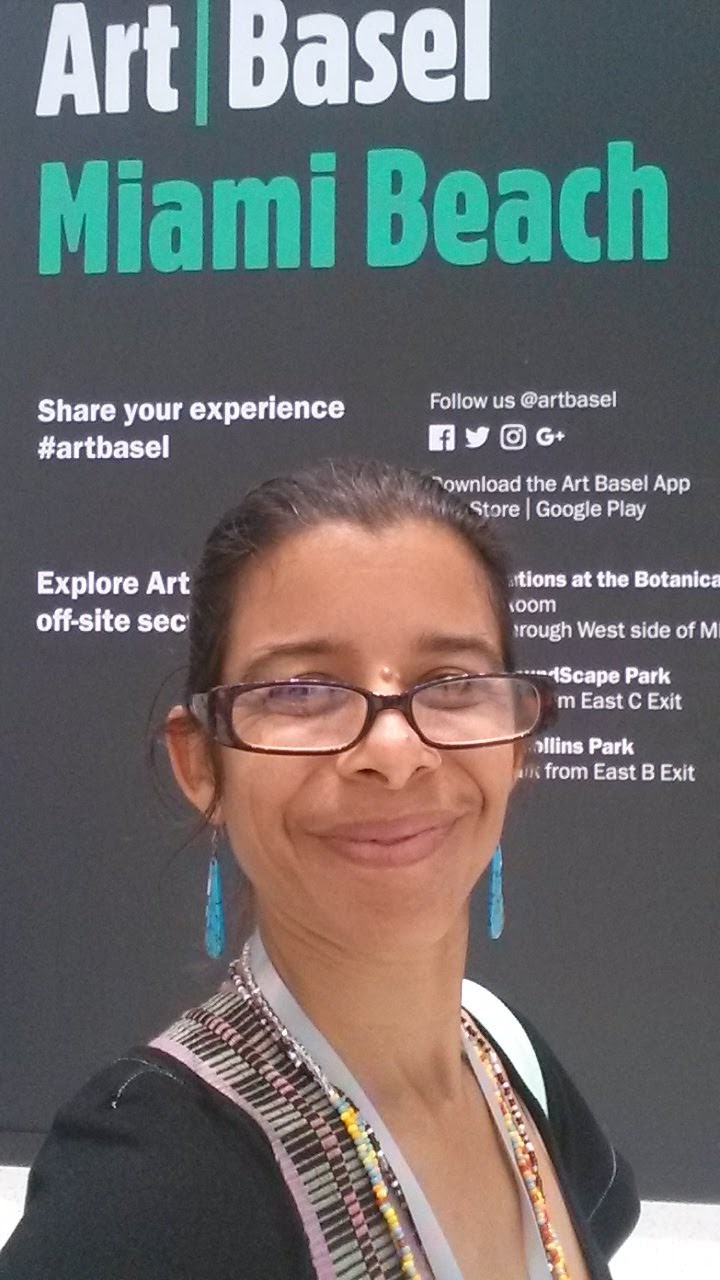
Yours truly #ByeBasel #selfie
Beyond Basel Saturday, December 16th, Tara Chadwick
will be sharing some of her particular style of "performance" art with the community in the Sistrunk
Neighborhood, everyone is welcome to attend. And on Tuesday, December 19th, a community tour of the #NativeArtattheCannonball exhibit is being offered to #Sistrunk residents and the public at 2 pm.
Sometimes our time markers, memory markers all happen to converge. Today is one of those days. First day of school of the last year of middle school for my older son and the first day of kindergarten for the younger one.
Four and three quarters of a year past the completion of the bundle of years we know as the baktun cycle of the Mesoamerican calendar.
Our young people are getting healthy, standing up, using their voices. Unity is on the rise. It is definitely the beginning of an era.
Our ancestors across this continent had and continue to have many different ways of honoring the particular point in the infinite dance of our universe that we recognize today as eclipses. There are scrolls and charts, sculptures and symbols to account for the calculations of the passing of time and the various markers used to keep track of the many cycles we observe. In some cases, we don't know what types of ceremonies or commemorations were held, while in other cases, the ancient traditions are still practiced within vibrant cultural communities.
In my own pleuri-cultural family, lunar eclipses, like the phases of the moon that greet us every day of every month of every year, remain a special and sacred time of reflection, quiet contemplation, care and love. My grandmother would always stay up, notice, watch and sing a beautiful rendition of "big lady moon" in her low lullabye voice, while my grandfather would always join us for a moment, then retreat to his sleeping quarters. The instructions we are to follow as human beings remain clearly written on our hearts, we have only to clear our minds enough to follow them.
In the cities of our Maya ancestors, urban planners constructed cultural landscapes with central plazas in line with the location of the rising, setting and mid-day sun on the days of the summer and winter solstice. Some cities, known for their scientific prowess in tracking the cycles of the planets and starts, contain ancient observatories, perhaps they even functioned as building-sized pinhole cameras or camera obscura.
In 1979 when I was six years old, I attended a Miami-Dade County public school called Comstock Elementary. I loved my reading book, "It Happened This Way," featuring a pink flamingo who had swallowed a pretzel on the front cover. I hated the standardized testing I was introduced to that year. I loved earning cheeze it cracker treats from my teacher by sitting quietly when it was rest time. And I remember the day all the teachers were worriedly reminding us not to look up at the sun. It was Miami's last total solar eclipse, and my most memorable day of school, ever. Kudos to all the teachers, principals and administrators who will do their best to ensure that no kids get solar blindness on their watch today.
As for me, I'm going to take a deep breath, take a few moments to reflect, and prepare to welcome in the start of a new era... maybe, hopefully, the sun will shine on our people once more....
Marie Huntley, aka Ms. Peaches is a force to be reckoned with in the Sistrunk community of Fort Lauderdale. An extremely talented singer, doer and community historian, Ms. Peaches is one of those people who is alway encouraging good stuff to happen in her neighborhood.
I've been thinking a lot about stories, storytelling, history and how we each find inspiration and encouragement to keep going in times of difficulty, and to go as far as we can in times of joy... about how we can see mirrors of our story in the histories of others... and how important our stories are, to ourselves, our families, and our communities. Together, our stories are our true history.
So often, we tell versions of history that have been learned from books, or elders, or the land and geographies that we've come through... but every once in a while, we get to reflect, and tell a little bit of the story that comes through us, from our own life experience. It is these nuggets of light, understanding, memory and insight that I find most impactful when listening to the words people share.
So, in the spirit of reclaiming our own narratives, telling our own stories, and with the encouragement of Ms. Peaches... here goes:
My story begins in the hearts of the continents we now know as America, Africa and on that island we now call the UK. My heartbeat began in the womb of a woman who survived a thousand wars, over six continents, from a seed planted by the grandson of a hunter who'd been on his island for almost a million years.
My parents remain one of the most unlikely odd couples to make it through 45 years of marriage in the most dire of social realities. One of the things they had in common was that they were both immersed in the lifestyle of 1950s anglican ministry. My mother talks about attending church sponsored after school activities every single day of the week. My father was an altar boy, though I don't ever remember his mother, my grandmother speak about church, except for christenings, weddings and funerals. But for all their early involvement in church, almost all my early memories are of being with my parents at parties, gatherings and outside on the land, either in the back yard, on a beach or near a river. I spent almost all my summers either scouring the Scarborough Bluffs or scampering up the steps of the Maya "pyramids" and sometimes, both! I didn't play video games or even board games, really, my toys were twigs, flowers and found objects. And my favorite pass time was sauterning along the edges of the water and the wilderness... in that respect, not much has changed.
My earliest memory of school is walking along the fence, picking up sticks, and using them to play the chain links like a piano, listening to the different sounds the metal would make depending on the size, length and width of each stick. I still remember a few of the songs and poems I learned in pre-school. My mother tells me that once, when I was four, we were walking in "The Guild Inn" and she couldn't find me anywhere... only to look around a large boulder to find me teaching a group of German tourists my favorite nursery school song, and they were singing it too, despite the fact that they spoke no English, nor I German. Art and teaching are in the blood. My mom and dad met teaching, I spent a year living with my Aunt while she was an art and history teacher, my sister taught art and, despite my mothers advice to the contrary, I also taught math and social studies through art for 7-12 graders. My passion now, though, is community based education. Those formal and informal learning opportunities we place in front of folks to learn something new, whether they thought they wanted to know or not. This translates well to a variety of interests, like community outreach, social media, museums, health, wellness, prevention programming and community building.
The work my mother put in to making sure that I know as fully as possible who I am propelled me to pursue a career in anthropology, archaeology, art and wellness. At the tender age of 17, I won an entrance scholarship to York University in my hometown of Toronto. Working my way through college, I spent my summers at the Government of Belize's Department of Archaeology, and winters working part time at the front desk of the Royal Ontario Museum and as a research assistant to Dr. Elizabeth Graham. I had so many wonderful women helping me learn during these adolescent years: Pauline Shirt, Deanna Sheridan, Sadie Buck, and the late Shirley Shilling & Irma Martin, just to name a few of the feminine forces that helped shape my world.
Eventually, once I finally graduated, I went back to the Belize Department of Archaeology to work as staff Museologist/ Curator as part of the Maya Area Sites Development Programme. When that grant funded project was complete, I took what I thought would be a two month break to spend time with my aging grandparents back in Toronto. That break led to an unexpected two year apprenticeship with one of Indian Country's most well known educators, Dr. Edward Benton Banaise. At the conclusion of working to help develop (and name) his most recent publication: Anishinabe Almanac, I once again thought I'd be heading home to my mother's land in Mesoamerica. This time, it was the opening of a community based school chartered specifically to teach Native American youth through an integrated arts approach that kept me grounded in the Midwest. It would be another 13 years before I finally got the call from my mother that it was time I returned to their chosen home halfway between Mesoamerica and the Great Lakes: The Greater Everglades region, right here in #OurMiramar.
So after earning my Bachelor of Arts Degree, being made Midewiwin, earning my Mexica traje, and working alongside some of the very best educators, historians, community builders and storytellers, I packed up the treehouse apartment, and headed back to the Sunshine State. That was four years ago now. I've completed all my life goals, except one: to relearn one of my ancestral Maya languages. I know words here and there, from the study of archaeology and danza, but to be able to string those together in a sequence, to speak thought into being through language, my language... that is the one thing I have yet to do on this earth... hopefully before it's time for me to return my borrowed bag of bones to the Mother Earth from whence they were constructed.
We all come to this conscious part of Earth with a gift and for a purpose. Mine is to be as fully who I am as I can. It's a journey that I'm still on, still struggling with every day, and also one in which I find great joy and satisfaction. I hope that sharing this small piece of who I am will help to encourage someone out there to pursue their passion a little further, persevere a little longer and reach a little higher, for what we aspire to is what we are here to do.
#MesoamericanDanza presentation at Treehugger Organic Farms
Today we said our farewell to a piece of land that has sustained us and our community here in South Broward County for the past 4 years... a permaculture oasis in the midst of the concrete jungle we know as South Florida, east of the Everglades... a local food sanctuary known as Treehugger Organic Farms, now listed as permanently closed on your google GPS mapping system.
It was a bittersweet walk through the daikon radishes, lesser known banana species, greens, fruit trees, birds and butterflies. This farm felt like home, that safe place you can go to for peace, quiet, and tenderly cared for oceans of green.
A post shared by Scott Evan Schlossman (@iloveushutup) on
There was a food forest on a mulch hill, a coconut grove interspersed with comfrey plants, florida nopalitos, tumeric and ginger, a spring fed pond that supplies water to the farm, and rotating fields of boniato, tomato, kale, collards, mustard, fennel, spinach, beans, millet, sugar cane, and just about everything in between.
One day after the mega #PeoplesClimateMarch in several cities, and on the eve of #InternationalWorkersDay, it seemed like a huge mountain to move. The reality of agricultural land tenure here in Florida is that access to farmable land is unstable, market based, and temporary. In reflecting, I realize that personally, I subscribe more to the Haudenosaunee approach to land management whereby we humans are responsible to protect, nurture and strengthen the land/ soil/ earth, on behalf of it's only true owners, that generation of unborn children who has not yet arrived here via the miracle we know as birth.
Miami Herald photo by Al Diaz
What a timely consideration given the fact that I am, for the first time in my life, the biological auntie to one of these not-yet-born owners of the earth. But in the volatile market economy that most of us are engaged within by choice or necessity, land is but a commodity, like humans once were, to be bought, sold and traded at the will of those who believe themselves to be in positions of power over others.
But this momentary twinge of grief in losing a space in which to enjoy the company of others, and ourselves in the company of Mother Earth and her pretties, is just a reminder that in fact we are owners of nothing, but rather bearers of ideas, thoughts, insights, and the potential to seed a new generation of humans with the capacity to return to a life steeped in nature, health and harmony with the cycles of all living beings including the soil, rock, sand and oil that make up the material we know as earth.